
HOW WE WORK
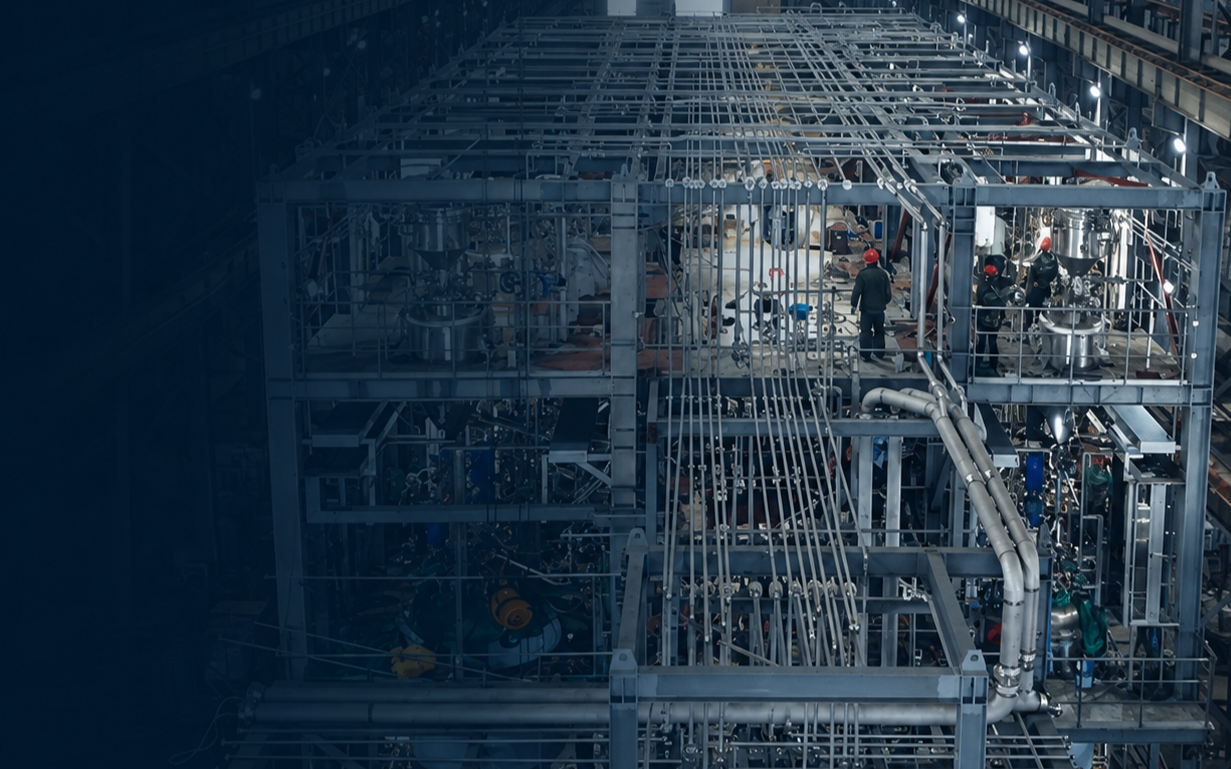
A disciplined modular project flow moves more work into a controlled fabrication environment before equipment reaches the field.
A Structured Flow from Engineering to Site Integration
EXECUTION APPROACH
A structured project path form engineering and procurement through fabrication, testing, delivery, and site integration.
Typical execution.
01
Engineering & Process Design
Multi-discipline teams develop the process design, equipment arrangement, interfaces and documentation required for modular execution.
02
Integrated Procurement
Equipment, materials, and supplier activities are coordinated with engineering and the module build sequence..
03
Concurrent Fabrication
Equipment, piping, structural, electrical, and other project scopes are integrated within the modular build.
04
Inspection, Testing & Verification
Inspection, testing and verification are completed throughout fabrication and prior to release for delivery.
05
Coordinated Delivery
Transportation and logistics are planned around module dimensions, project location, route requirements, and site readiness.
06
Site Integration
Modules arrive prepared for installation, connection, commissioning, and final integration
CONCURRENT EXECUTION
Engineering, procurement, fabrication, testing, and logistics can advance in parallel where project requirements allow, helping reduce sequential delays and support schedule certainty.
Executing 10 industrial modular plants — simultaneously.
Design and project interfaces progress alongside with engineering and fabrication priorities
Engineering
Procurement
Equipment and material sourcing are aligned with engineering and fabrication priorities
Fabrication
Module fabrication and integration progress through coordinated toward project readiness.
Testing & Delivery
Inspection, testing, documentation, and logistics are coordinated toward project readiness.
FOUR REASONS MODULAR
Modular execution shifts substantial project scope into a controlled fabrication environment while allowing site activities to progress separately where practical.
Four advantages of modular execution.
Shorter Schedules
Parallel site work and module fabrication compress the overall schedule.
Safer Execution
Complex assembly and integration can be completed in a controlled fabrication environment.
Reduce site labor
Substantial scope arrives integrated, reducing field assembly and site-intensive work.
Greater Delivery Certainty
Controlled fabrication, inspection, and testing support a more predictable path to site.
Logistics & Delivery
Transportation planning is integrated with module design, route requirements, handling, and site readiness to support safe and efficient delivery.
A coordinated path from fabrication to site.
01
Transportation Preparation
Modules are prepared for shipment based on dimensions, handling requirements, route constraints, and project specifications.
02
Controlled Logistics
Transportation, handling, documentation, and delivery activities are coordinated around the project schedule.
03
Final Site Delivery
Modules are delivered to the project site in coordination with access, lifting, installation, and site-readiness requirements.
Have a Process That Could Be Modularized?
Tell us about your process requirements, project location, execution schedule and major equipment scope. Our team can help evaluate how a modular approach could fit the project.